
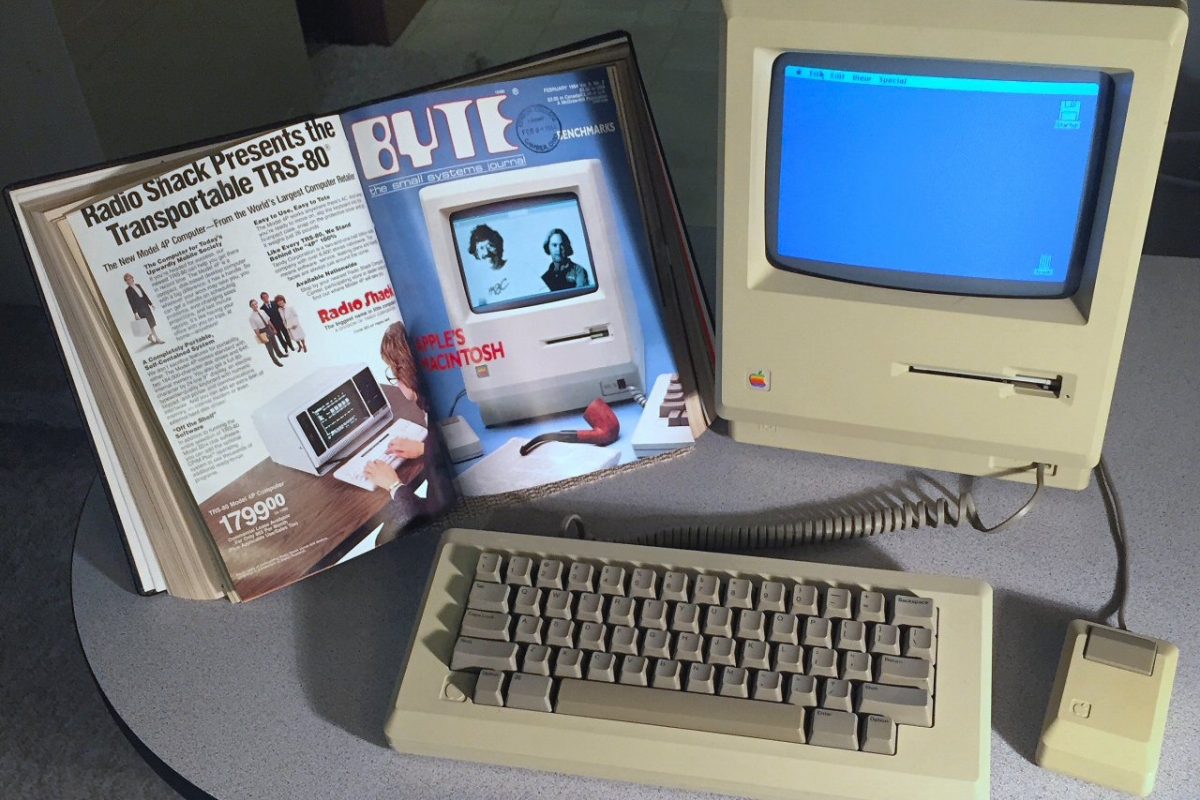
Why is it that seeing a modern ad is so annoying while old TV commercials and magazine spreads so frequently make us laugh and smile? Is it the attempted manipulation, disarmed by the passage of time? Or maybe the obviousness of modern pitches and the uncanniness of those we find in time capsules? “I feel like the ads from the older days were more earnest and quirky and fun in many ways than they are now,” tech historian Benj Edwards told me in an email.
Open any old issue of Computer Shopper, Byte, or PC World and chances are good you’ll see a full-page photograph of a wizard casting a healing spell on his Atari. Or the suggestion that Leonardo DaVinci would have done better painting the Mona Lisa on a Commodore 64. Or a Benjamin Franklin actor drafting the Declaration of Independence on an Apple IIe. There was a neverending supply of old white men in silly costumes making overcomplicated metaphors about the power of technology.
Email fit perfectly into the computer magazine advertising formula of the 80s. It had a historical analog to reference in snail mail and was already extremely popular among ARPANET researchers. But much of what was labeled “electronic mail” in the 80s was very different from what we would call email today. “There's a distinction to be made that commercial online and email services were notably different,” Benj says. “It took big, expensive machines to process and route emails to other people.” So companies sold the idea of email instead of the real thing, enterprise communication in lieu of decentralized messaging and proto-social media networks rather than interoperable mail. It was kind of a bummer. But the ads were incredible.
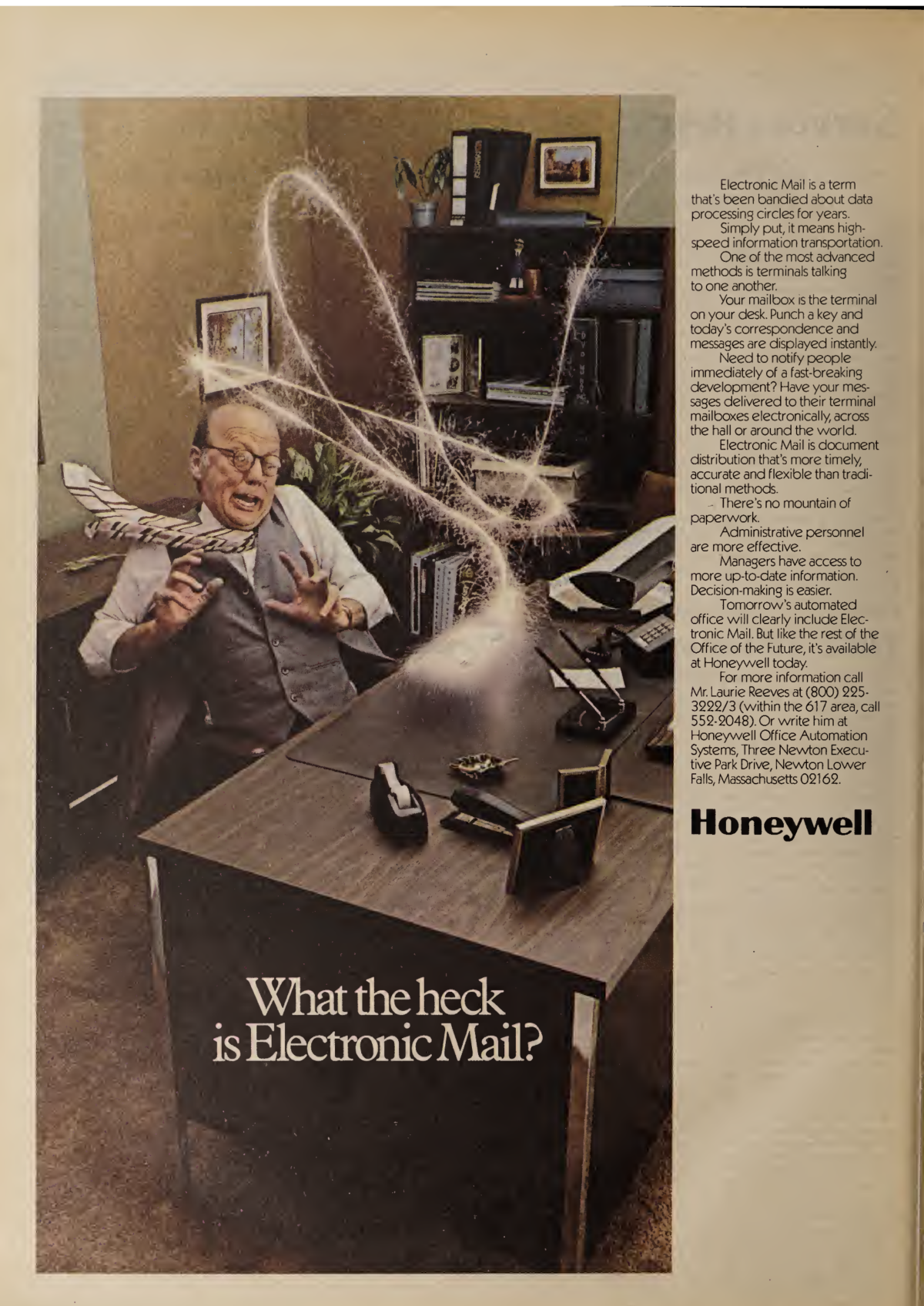
Honeywell’s email ad is one of the most famous examples of nutty ‘80s tech marketing, for obvious reasons. There’s the implication that every arriving email will be startling and violent enough to blast your necktie out of your vest. And the baffling decision to describe electronic mail as “your mailbox is the terminal on your desk” and then photograph a desk without a terminal on it. It’s beautiful and I love it.
I couldn’t tell you what the heck Honeywell was even selling here without more context from the Internet Archive. Set the search type to Text contents and the query to Mr. Laurie Reeves’ phone number (because yes, nationwide ads used to include salespeople’s direct lines) and you’ll see a 1981 issue of Computerworld alongside a few other Honeywell ads from the same campaign, all with the same LinkedIn the 80s vibes.
“I think this campaign referred to the Honeywell Level 6 operating system,” Tom Van Vleck wrote in The History of Email. That OS included an “Executive Mail” interface that was little more than a thin layer atop Multics’ mail command from years earlier. And who wants electronic mail from the 70s when you could have something from the Jetsons era?
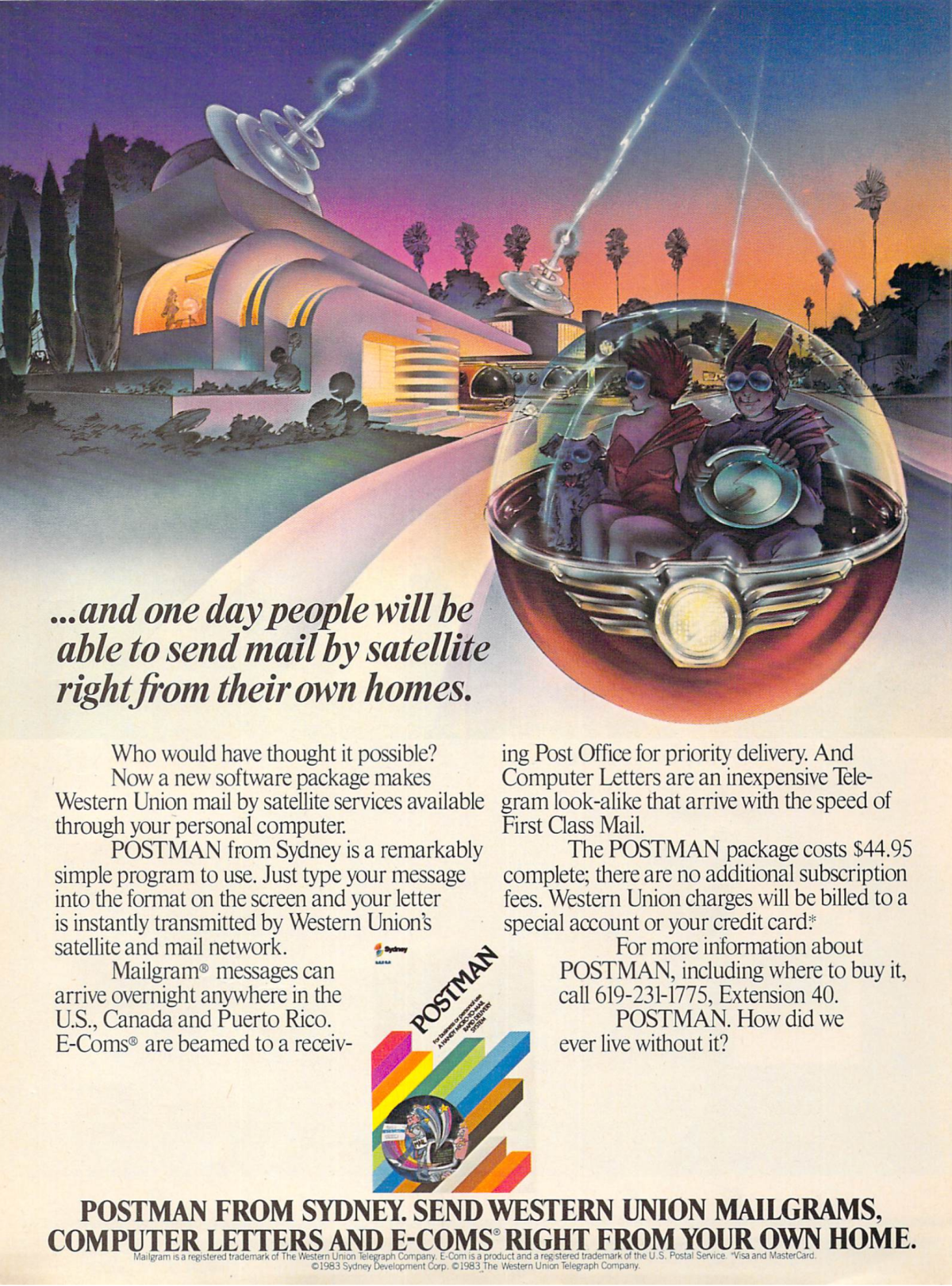
First, there was USPS’s E-COM program, an attempt to create a “monopoly over delivery of hard copy associated with electronic messages.” You’d send a message via teleprinter to one of 25 post offices that were equipped to receive, print, and then deliver your email as if it were snail mail. This POSTMAN ad from PC World in December 1983 added another layer, routing you through Western Union and its geosynchronous Westar Satellite network to get your email to the nearest office for a paper delivery.
There were three pay-per-email options according to a POSTMAN Product Bulletin: Mailgram ($3 for the first page), E-COM ($1.50), and Computer Letter ($1.35), with the program letting you “choose to be billed by Western Union directly or use your Visa or Mastercharge,” before your payment details were “transmitted electronically to Western Union.” Rooftop lasers and orb-shaped flying cars were not included with purchase, as far as I can tell.
POSTMAN even let you store up to 30 recipient addresses! They were postal addresses included in your “electronic mail” to Western Union, but still, this was one of the few ways to easily send messages from your computer in the early 80s. If you wanted someone to actually read your email on their own computer, popular “online services” that Benj referenced were a compromise that didn’t require running a server, tedious protocol coordination, or source-routed addresses.
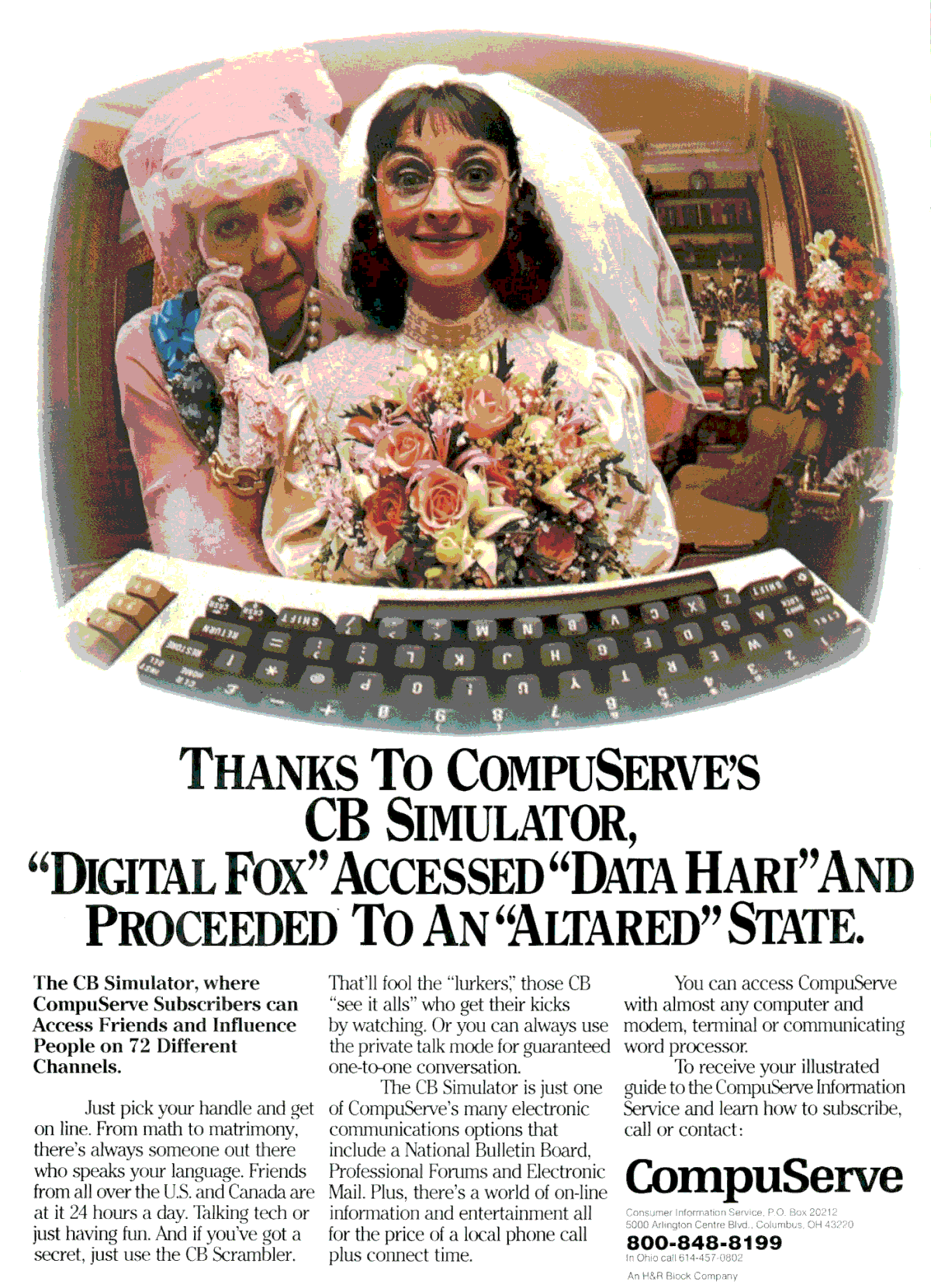
Ignoring the totally unexplained user nicknames (the phrases in quotes), matrimony as a “language,” and normalized voyeurism, this CompuServe ad from 1984 also had webmail. Sort of. You had to have a CompuServe account and could only email other CompuServe users (with a portal to “search the directory for other subscribers based on their user ID number, name, city, interests, or computer brand”). But it had subject lines, reply and forward buttons, and an option to download a message to read offline, in 1984!
More social network than email, every CompuServe user received a unique nine-digit number (formatted as 12345,6789) as their ID and a randomly generated two-word passphrase for electronic email. One user in /r/ObscureMedia remembers how “My email was something like 75341.3452@cs.com. They used a string of octals as their usernames all starting with 7 because of PDP-10 architecture.” The same year the Altared State ad was published CompuServe claimed 110,000 paying subscribers, tripling that number within a few years.
Unlike POSTMAN, you were paying per minute of connection rather than per sent message. “They were selling a service at a metered rate rather than a physical product, so it wasn't something that you bought once and never again,” Benj recalled to me. “It was a gateway to a world where tech-centric businesses could expect regular repeated income like a subscription.” And it was immensely sticky. Who would leave a service after finding people also wanted to message about math and matrimony?
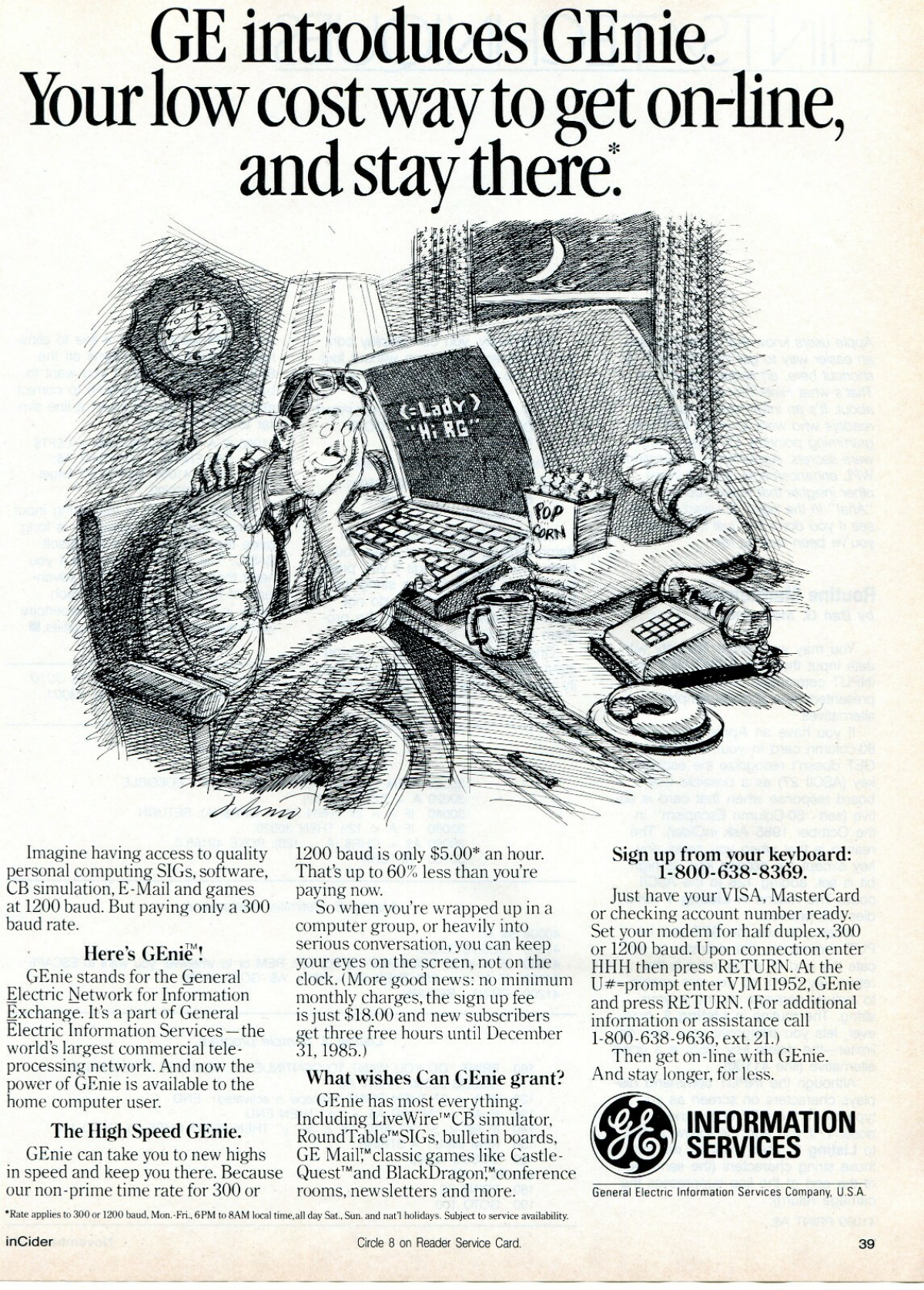
If there’s one thing I’ve learned from digging up old computer ads it’s that they only get more ridiculous the longer you look at them. Sure, there’s the 2am chat with “Lady,” but the anthropomorphized computer hug kind of flies under the radar. And the popcorn feels pretty gross the longer you think about it. Still, this 1985 GEnie ad from Microcomputing Magazine is one of the clearest explanations of how people often messaged during this era.
GEnie, especially its mail system, was nearly identical to CompuServe’s. It had the same headers, you could send a single message to multiple recipients, and there was even an option to upload a text file from your computer. The GEnie User Guide claimed that you could also “use the Cancel command to delete a letter after you have already sent it. All you need to know is the item reference (that's the 7 digit number assigned to every letter).” Presumably only erasing the message if you canceled it before Lady logged in.
Checking your GEnie inbox during daytime hours was anywhere between $18 and $36 per hour ($55-$110 in 2026 dollars), while off-peak nighttime hours were $5. For a service with only 12,000 subscribers! There were a slew of modems that let you schedule a connection at witching hours to send and receive messages while you slept (my favorite being one that advertised Paul Revere sleeping through the British invasion.
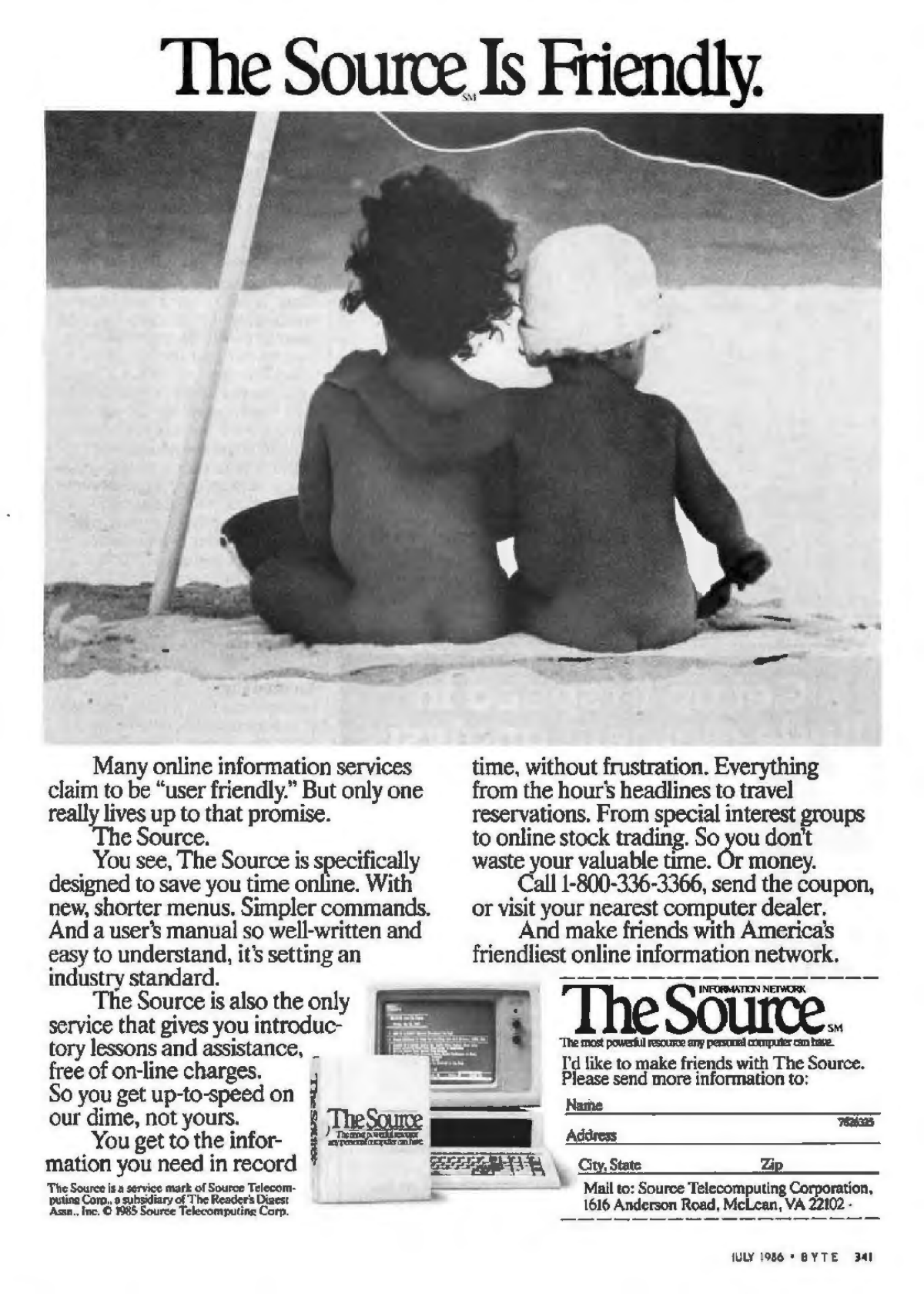
Less popular than CompuServe and GEnie, The Source had…babies? That and "Instant terminal-to-terminal, member-to-member mail delivery — around the corner or around the globe." It was a service started by William von Meister (who went on to help launch AOL) before The Reader’s Digest Association purchased a controlling stake for $6 million.
The Source had barely reached profitability by the time this ad ran in a July 1986 edition of Byte, seven years after Isaac Asimov declared the service “the start of the information age.” The Reader’s Digest plan was to target wealthy business users making online stock trades (again, why babies at the beach?), but electronic mail was the overwhelmingly popular activity of choice on the platform.
By 1989, The Source’s subscriber base had shrunk to 1/10th the size of CompuServe’s and was acquired by the competitor. But eventually even CompuServe started losing out to more open, interoperable networks, like FidoNET, BITNET, and eventually the Internet. CompuServe created an email gateway in 1989 and, suddenly, anyone could send you mail at [USERID]@compuserve.com. Email clients like PINE and Eudora developed cult followings and pay-per-minute or per-hour messaging disappeared, along with the ads that tried, and failed, to define it.
“The fact that sending an email was once the basis of several entire commercial services seems pretty odd in today's context because we take email for granted as a free, simple thing,” Benj explained. “That's the story of technology: whatever seems big and complex now will be taken for granted in the future, become nearly free, and will be integrated into other, larger, and more complex products.”
Showcasing ads like these started as a way for Benj to keep his blog content flowing. But it became “a little water-cooler community of people remembering details about the ads or products.” Maybe that’s why retro ads are so comforting. They remind us of a time when the internet was an occasional diversion. A place we could visit and disconnect when we wanted. Or when your service switched to daytime rates.
| Image | Credit |
|---|---|
| Header photo of a collector’s Byte magazine collection | inanis.net |
| What the heck is electronic mail? | Archive.org |
| POSTMAN software advertisement | Archive.org |
| CompuServe magazine ad | Archive.org |
| GEnie magazine advertisement | Archive.org |
| The SOURCE magazine advertisement | Archive.org |